
Product Categorys
MIM
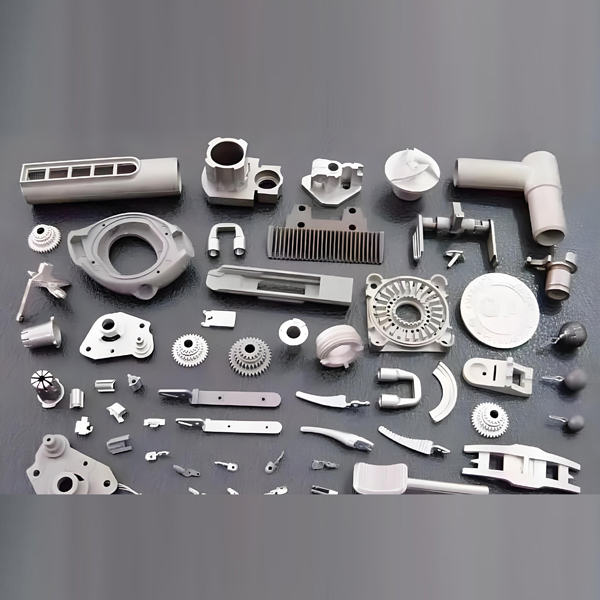
Contact UsMetal Injection Molding (MIM) is a highly advanced manufacturing process that beautifully combines the design flexibility of plastic injection molding with the strength, durability, and material properties of forged metal. By mixing fine metal powders with a binding agent, MIM can produce highly complex, net-shape metal parts with exceptional precision, making it an ideal solution for small, intricate components that are difficult or impossible to machine.
⚙️ How Metal Injection Molding Works
The MIM process transforms raw metal powder into dense, solid metal parts through a precise, four-step sequence:
1. Mixing (Feedstock Preparation): Ultra-fine metal powder (typically 1-20µm) is thoroughly blended with a thermoplastic binder and wax. This mixture is then cooled and pelletized into a granular "feedstock," which behaves much like plastic pellets.
2. Injection Molding: The feedstock is injected into a multi-cavity mold using standard injection molding machines. This creates a "green part" that holds the exact shape of the final component, albeit oversized to account for the shrinkage that will occur later.
3. Debinding: The green parts undergo a process to remove the majority of the binder material, either through solvent extraction, thermal evaporation, or catalytic reaction. The resulting part is called a "brown part"—it is fragile and porous but retains its shape.
4. Sintering: The brown parts are placed in a high-temperature, atmosphere-controlled furnace. The remaining binder is completely vaporized, and the metal particles fuse together (sinter), shrinking isotropically (uniformly in all directions) by about 15-20% to form a highly dense, solid metal part.
✨ Key Advantages
MIM is renowned for its ability to deliver complex geometries at scale, offering several distinct benefits:
· Complex Geometries: It can easily produce intricate 3D shapes, thin walls (≤1mm), internal channels, and fine details that would be impossible or prohibitively expensive with CNC machining or traditional powder metallurgy.
· High Material Utilization: MIM is an incredibly efficient process, with material utilization rates often exceeding 95%, significantly reducing waste compared to subtractive manufacturing methods.
· Excellent Mechanical Properties: The high-temperature sintering process results in parts with a density of 95-99% of theoretical density. This gives them mechanical properties (strength, hardness, toughness) that are nearly identical to forged or machined metals.
· Cost-Effective at Scale: While the initial mold design and fabrication can be costly, the per-unit cost drops dramatically for medium-to-high volume runs (typically 5,000 to millions of parts), making it highly economical for mass production.
· Superior Surface Finish: MIM parts emerge from the mold with a very smooth surface finish, often reducing or eliminating the need for secondary machining or polishing.
Common Applications & Industries
Because of its ability to create small, complex, and high-strength parts, MIM is widely used in demanding, high-tech sectors:
· Consumer Electronics: Manufacturing intricate components like smartphone SIM card trays, foldable phone hinges, smartwatch casings, and fiber optic connectors.
· Medical Devices: Creating highly precise, biocompatible parts such as surgical instrument handles, orthodontic brackets, and components for drug delivery systems.
· Automotive: Producing durable, lightweight components like turbocharger vanes, sensor housings, seatbelt components, and fuel injection parts.
· Firearms: Fabricating complex, high-stress components such as triggers, safety catches, and magazine releases.
· Aerospace: Manufacturing lightweight, high-temperature-resistant parts like engine components, flap screws, and satellite hardware.
Materials Used in MIM
A major strength of the MIM process is its compatibility with a wide variety of materials, allowing engineers to select the perfect alloy for the application:
· Stainless Steels: Such as 316L (for corrosion resistance in medical devices) and 17-4PH (for high strength in aerospace).
· Low-Alloy Steels: For general-purpose, high-strength structural components.
· Titanium Alloys: Ideal for applications requiring high strength, low weight, and excellent biocompatibility.
· Tungsten Alloys: Used where extreme density and high-temperature resistance are required.
· Specialty Alloys: Including soft magnetic alloys for electronics and tool steels for wear-resistant parts.
In summary, Metal Injection Molding (MIM) provides a unique and powerful solution for manufacturing small, complex, and high-performance metal parts. It bridges the gap between the design freedom of plastics and the robust performance of solid metals, making it an indispensable technology in modern precision engineering.